
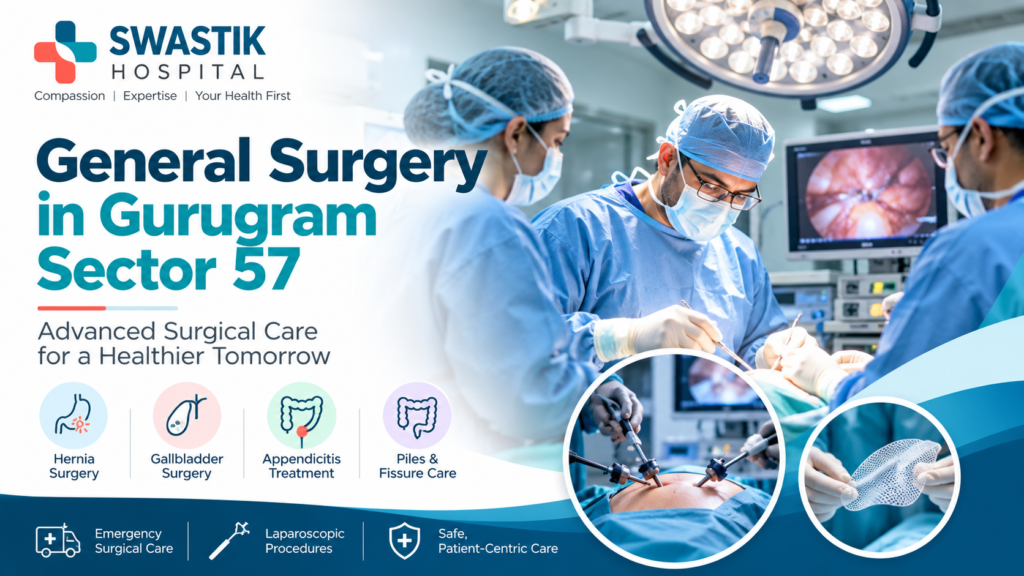
Prepared by the clinical content team and reviewed by the General Surgery team, Swastik Hospital, Sushant Lok 2, Sector 57, Gurugram. Last updated: 24 October 2026.
The word “surgery” has a way of making a dull ache feel like a verdict. A lump in the groin that has been there for months. A stomach pain that comes back after fatty food. A fissure you were too embarrassed to mention. People put off seeing a surgeon for exactly these everyday problems, and the delay is usually what turns a simple procedure into an emergency.
This guide explains what general surgery covers, which conditions need it, what to expect, and when to stop waiting and walk into a hospital in Sector 57, Gurugram.
Quick answer: General surgery treats common conditions of the abdomen and digestive system, plus lumps, wounds and infections that need an operation. Typical examples are hernia, gallstones, appendicitis, piles, fissure, fistula and abscess. Many of these can be treated with keyhole (laparoscopic) surgery, with quicker recovery. Sudden severe abdominal pain, a hard painful lump that will not go back in, or heavy bleeding needs emergency care immediately.
What does a general surgeon treat?
A general surgeon is trained to diagnose and operate on a wide range of problems, mostly in the abdomen. At Swastik Hospital, the general surgery department handles:
- Hernia (inguinal, umbilical and incisional)
- Gallbladder stones and gallbladder removal
- Appendicitis and appendix removal
- Piles, fissure and fistula
- Abscess drainage and wound care
- Soft-tissue lumps and minor and major surgeries
- Emergency surgery for acute abdominal conditions and injuries
Common conditions, in plain language
Hernia
A hernia is a bulge that appears when part of the intestine or fatty tissue pushes through a weak spot in the abdominal wall. It does not heal on its own and tends to grow slowly. Surgery repairs the weak area, often with a mesh. Read our detailed guide to hernia symptoms and treatment in Gurugram.
Gallbladder stones
Stones can cause repeated pain in the upper right abdomen, often after a heavy or oily meal, with nausea or bloating. If symptoms keep returning, the standard treatment is removal of the gallbladder by keyhole surgery. Learn more in our article on gallbladder stone treatment.
Appendicitis
Typically it starts as pain around the navel that shifts to the lower right abdomen, with fever, vomiting and loss of appetite. This is a surgical emergency, because a delay can lead to a burst appendix.
Piles, fissure and fistula
These anal conditions are common and very treatable, yet many people suffer in silence. Symptoms include bleeding after passing stool, pain, itching or discharge. Early treatment, sometimes with diet changes and medicines alone, avoids the need for major surgery.
Abscess and lumps
A painful, swollen, warm collection of pus usually needs to be drained by a surgeon. Lumps that grow, change or cause pain should always be examined.
Signs you should see a surgeon soon
- A bulge in the groin, navel or an old scar that grows when you cough or stand
- Repeated upper abdominal pain after meals
- Rectal bleeding, pain or a persistent swelling near the anus
- A lump that is growing, hard or painful
- Abdominal pain that does not settle in a day or two. See our guide to abdominal pain causes and warning signs.
Go to the emergency room immediately if…
- Abdominal pain is sudden, severe or getting worse, especially with fever or repeated vomiting
- A hernia becomes hard, tender, discoloured or cannot be pushed back, which may mean its blood supply is cut off
- You have heavy bleeding, black stools or vomit blood
- Yellow skin or eyes appear with fever and pain
- The abdomen is rigid and swollen after an injury
Swastik Hospital offers 24×7 emergency care. Please call ahead if you can, but do not delay reaching help.
Keyhole (laparoscopic) vs open surgery
In keyhole surgery, the surgeon operates through a few small cuts using a camera and fine instruments. For suitable patients, it generally means less pain, smaller scars, shorter hospital stay and faster return to routine. Open surgery is still the better, safer option in some situations, such as complicated or emergency cases, and the surgeon will choose based on your condition, not on fashion.
How the process works
- Consultation: history, examination and a clear explanation of your condition.
- Tests: blood work through the in-house laboratory, plus ultrasound or other imaging when needed.
- Pre-operative planning: a review of medicines (especially blood thinners and diabetes tablets), and fasting instructions.
- Surgery and observation: done under anaesthesia, followed by monitoring. Complex cases get higher-level care through the hospital’s ICU when required.
- Recovery and follow-up: wound care, diet advice and a review visit.
Typical recovery (a general guide)
- Gallbladder removal (keyhole): many people resume light work in about a week
- Hernia repair: light activity in days; avoid heavy lifting for several weeks as advised
- Appendix removal: usually one to two weeks for routine activity
- Piles, fissure or fistula surgery: a few days to a couple of weeks, with diet and hygiene care
These timelines vary with age, health, the exact procedure and whether surgery was planned or emergency. Your surgeon will give you specific instructions.
Questions to ask before you agree to surgery
- Is surgery necessary now, or can I wait and monitor?
- Are there non-surgical options for my condition?
- Will it be keyhole or open, and why?
- What are the risks and what happens if there are complications?
- How many days will I stay, and when can I work and drive?
- What is included in the cost estimate, and what is not?
Why patients choose a local hospital in Sector 57
For families in Sushant Lok, Sector 56, Sector 55, South City and nearby Gurugram sectors, a hospital close to home matters when pain strikes at 2 AM. Swastik Hospital is a multi-speciality hospital at 2119, near Rohit Department Store, Block G, Sushant Lok 2, Sector 57. Alongside general surgery, patients can access general medicine, diagnostics and emergency services under one roof. Meet the team on our specialist page, read patient testimonials or see the hospital photos. You can also read about Swastik Hospital.
Frequently asked questions
What is general surgery?
General surgery treats common conditions mainly of the abdomen and digestive system, such as hernia, gallstones, appendicitis, piles and abscesses, along with lumps and emergency surgical problems.
Is there a general surgery hospital in Gurugram Sector 57?
Yes. Swastik Hospital in Sushant Lok 2, Sector 57, Gurugram offers general surgery with 24×7 emergency care, laboratory and imaging services.
Can a hernia go away without surgery?
No. A hernia does not heal by itself. Surgery is the only permanent repair, and early treatment is usually simpler and safer.
Is laparoscopic surgery safe?
Yes, in suitable patients it is a well-established, safe technique. Your surgeon will decide whether it is right for your condition.
How do I know if abdominal pain is serious?
Seek urgent care if the pain is sudden, severe or worsening, or comes with fever, repeated vomiting, a rigid abdomen, blood in stool or yellow eyes.
How long is the hospital stay for gallbladder or hernia surgery?
Many keyhole procedures need a short stay of one to a few days, depending on your health and the surgery. Your surgeon will confirm for your case.
Do piles always need surgery?
No. Early piles often improve with diet, fibre, fluids and medicines. Surgery is for larger or repeatedly bleeding piles that do not respond.
How can I book a consultation?
Use the contact page or call +91-8800897790 or +91-9953892166.
Not sure whether your symptoms need surgery? Book a consultation at Swastik Hospital, Sector 57, Gurugram and get a clear answer, not a sales pitch.